
Stepping into Caesarea Maritima is like walking straight into the pages of Scripture. With its sweeping harbor, Roman theater, and shoreline hippodrome, this ancient city remains one of the most striking Roman ruins in Israel. Built by Herod the Great and later governed by Pontius Pilate, Caesarea sat at the crossroads of culture, power, and faith—making it a pivotal site in biblical history and the spread of early Christianity. In today’s guest post, author Linda Dindzans takes us on a vivid journey through the remarkable Caesarea Maritima history that inspired scenes in her upcoming biblical novel A Certain Mercy.
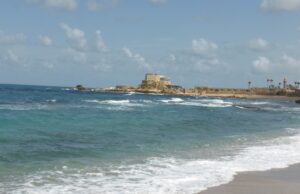
Of Harbors and Hippodromes — Caesarea Maritima
I’ve never met a period of history I didn’t find fascinating. No surprise, then, that the stories I write always seem to land in the perilous world of the Bible. Back in 2019, Vince and I traveled to Israel and made a stop at Caesarea Maritima on the Mediterranean coast. What an impressive place. It’s still the largest Roman ruin in Israel today, and you can feel the layers of history the moment you step onto the site.
Herod the Great transformed a tiny Phoenician port called Strato’s Tower into a massive, man-made harbor (22–10 BC), by using volcanic ash—pozzolana—that hardened underwater into “Roman cement.” He named it Sebastos (after Caesar Augustus). At the time, Sebastos was the largest man-made harbor ever built in open sea—an engineering feat that still makes you shake your head.
Around the harbor, Herod the Great created a full Roman city: a palace, a theater, aqueducts, and a sprawling hippodrome—a place of sport, spectacle, and survival. Herod didn’t just build a harbor—he built a city designed to impress Rome and curry favor with Caesar.
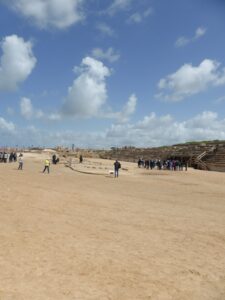
Caesarea’s hippodrome, stretching right along the shoreline, played a huge role in the city’s life. Crowds gathered for chariot races, athletic games, gladiator contests, and even public executions. Chariot racing here—just like in Rome’s Circus Maximus—was basically a war on wheels. Highly trained slave-drivers, called aurigas, raced two-horse chariots (bigae) or four-horse chariots (quadrigae). They weren’t alone out there: an outrider on horseback and a man on foot helped the charioteer manage those deadly tight turns and outmaneuver rival teams. Death was common, crashes called shipwrecks even more so. But for the handful who survived long enough, the rewards could be huge—wealth, fame, and sometimes even freedom.
Standing there in 2019, looking at the track and the stands, it wasn’t hard to imagine the roar of the crowd, the thunder of hooves, and the rumble of the wheels pounding the sand.
As a biblical-fiction author, I was hooked. How could I not use this setting? Book Two of my A Certain Future Series—A Certain Mercy includes several scenes set in Caesarea, including a life-or-death chariot race that still makes me hold my breath when I think about writing it.
Rome Takes Control
By 6 AD, Rome took over the region and put it under the authority of governors, or prefects. During Jesus’ ministry, that prefect was Pontius Pilate (26–36 AD) who lived in Caesarea, the Roman administrative and military headquarters—a bustling mix of Greeks, Jews, Romans, and travelers from all over the Mediterranean.
Jerusalem, on the other hand, was ancient, sacred, and constantly on edge. Pilate only went there when he absolutely had to—usually during major festivals or times when trouble was brewing.
The Pilate Stone: A Name Set in Stone
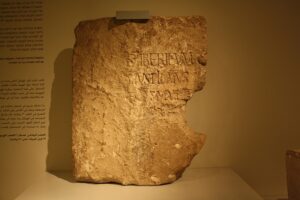
Historians had no physical proof that Pontius Pilate existed outside of written sources. But in 1961, archaeologists uncovered the now-famous “Pilate Stone.” carved with a dedication to Emperor Tiberius by Pontius Pilate, Prefect of Judea.
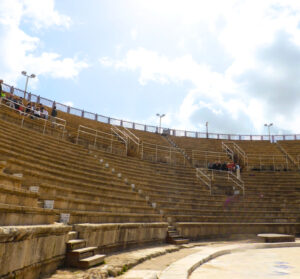
The repurposed stone was built into a staircase near the Herodian theater. To this day, it remains the only artifact that bears Pilate’s name. Before its discovery, we only knew of him through texts—the New Testament, apocryphal writings, and the works of Josephus, Philo, and Tacitus.
Caesarea in the Book of Acts
Caesarea shows up often in early Christian history:
- Cornelius and the Gospel to the Gentiles (Acts 10): This is where Peter preached to the Roman centurion Cornelius and saw the Holy Spirit fall on Gentiles for the first time.
- The Death of Agrippa I (Acts 12:19–23): Herod the Great’s grandson died here after accepting worship during public games—likely inside the hippodrome.
- Paul’s Travels: Paul sailed to and from the city many times (Acts 9, 18, 27).
- Paul’s Imprisonment: He spent two years under house arrest in Caesarea (Acts 23–27).
- The First Jewish Revolt: The revolt erupted in Caesarea in 66 A.D. After Jerusalem fell in 70 A.D., Titus forced 2,500 Jewish prisoners to fight to the death in Caesarea’s stadium as part of his victory celebrations. The treasure Rome seized from the revolt likely helped fund construction of the Colosseum.
A Launching Point for the Gospel
With its major port and diverse population—and as the first place where Gentiles openly received the gospel—Caesarea became a natural launching point for spreading Christianity far beyond Judea.

Linda Dindzans, M.D. is a writer with the heart of a healer who offers readers stories of redemption and restoration. Though her compelling characters inhabit the treacherous times of the Bible, Linda believes the struggles of her characters still speak to hearts today. Her debut novel A Certain Man was released in August 2024. Her next novel A Certain Mercy (December 2025) features several scenes set in Caesarea.
FB: Linda Dindzans
Website: lindadindzans.com





























































































 Email:
 Address: 15 Lucky Lane
 Phone : 501-289-9319